China Top Wall Mounted Bicycle Parking Rack Manufacturer
A reliable Wall Mounted Bicycle Parking Rack begins with practical design, not attractive drawings alone. In busy apartments, schools, offices, and bicycle shops, every centimeter matters. Our manufacturing experience focuses on stable storage, smooth handling, and efficient wall use. We study bicycle frames, tire widths, handlebar clearance, and common mounting heights before confirming a solution.
Details matter. A rack should hold a bicycle securely without scratching its frame or blocking nearby paths. Steel selection, weld consistency, surface treatment, and anchor compatibility all influence long-term performance. We can provide options such as powder-coated finishes, stainless steel components, folding arms, and customized dimensions. Each production stage requires inspection, from raw material checks to weld review and packaging control.
No rack fits every wall. That is worth admitting. Brick, concrete, and lightweight partitions require different installation decisions. A strong product can still fail when the wrong anchors are used. Our technical team supports drawings, sample evaluation, installation guidance, and application-based recommendations. Load testing and dimensional checks help reduce avoidable problems, although real sites may reveal details that factory testing cannot predict. Clear communication remains essential.
Choose practical evidence over exaggerated claims. Review material specifications, mounting instructions, production capacity, and quality records before placing an order. As an experienced China manufacturer, we aim to deliver dependable Wall Mounted Bicycle Parking Rack solutions for residential, commercial, and public environments. Better storage should feel simple, safe, and durable. Small improvements count.
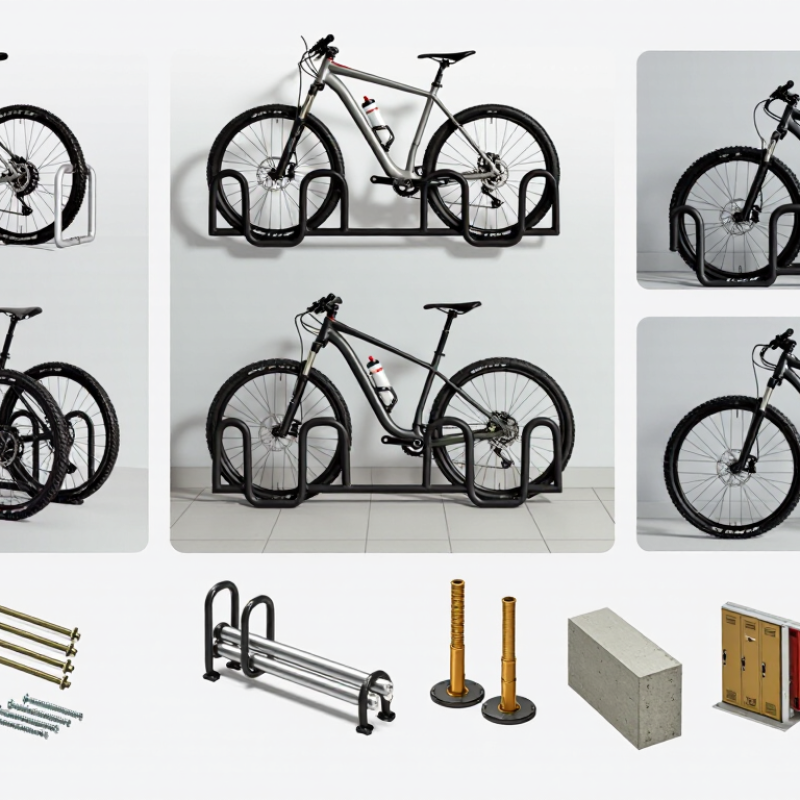
What Is a Wall-Mounted Bicycle Parking Rack? Definition and Core Functions
A wall-mounted bicycle parking rack is a fixed storage system that holds a bicycle against a vertical surface. Unlike a simple hook, it should support the bicycle frame securely and leave enough room for a lock. The Association of Pedestrian and Bicycle Professionals recommends designs that support the frame at two points and allow users to secure the frame and wheel. The distinction matters. A rack that grips only the rim can bend a wheel or create an unstable load.
Its core functions are security, space efficiency, protection, and orderly access. Properly positioned arms can keep handlebars from striking nearby bicycles, while rubber contact points may reduce scratches on painted frames. CROW’s Design Manual for Bicycle Traffic commonly allows about 0.75 meters of width and 2 meters of length for one bicycle space. Wall systems can reduce floor congestion, especially in narrow corridors or basement rooms. Clearance is critical. The rack must match wall strength, bicycle weight, tire width, and user height. The U.S. Census Bureau’s 2023 American Community Survey places bicycle commuting at roughly 0.5% of American workers, yet parking demand is not limited to commuters. Students, delivery staff, and visitors also need reliable storage. In practice, designers sometimes underestimate turning space and front-wheel interference. That mistake is easy to make. A useful installation should be tested with different bicycle frames before production decisions are finalized.
China Top Wall Mounted Bicycle Parking Rack Manufacturer - What Is a Wall-Mounted Bicycle Parking Rack? Definition and Core Functions
| Data Dimension | Typical Specification or Fact | Definition and Core Function | Practical Considerations |
|---|---|---|---|
| Product Definition | A bicycle-support device fixed directly to a wall or structural vertical surface | It stores one or more bicycles by supporting the frame, wheel, fork, or handlebar, depending on the rack design. | The wall and fixing points must be suitable for the combined weight of the rack and bicycles. |
| Primary Storage Position | Vertical or horizontal | Vertical racks hold the bicycle upright against the wall, while horizontal racks support the bicycle parallel to the wall. | Vertical storage usually reduces floor occupancy; horizontal storage can make loading easier for some users. |
| Typical Capacity | 1 bicycle per individual rack; multi-bike systems commonly hold 2–6 bicycles | Capacity indicates the number of bicycles the rack is designed to support safely. | Actual capacity depends on the rack structure, wall strength, bicycle spacing, and the manufacturer’s load rating. |
| Common Materials | Powder-coated steel, stainless steel, or aluminum | The material provides structural support and influences corrosion resistance, weight, appearance, and service life. | Outdoor installations generally require weather-resistant finishes or corrosion-resistant metal. |
| Typical Bicycle Compatibility | Standard bicycles; compatibility varies by tire width, wheel size, frame shape, and handlebar width | The rack must contact an appropriate part of the bicycle without damaging cables, rims, frame tubes, or painted surfaces. | Fat-tire bicycles, cargo bikes, bicycles with unusual frames, and e-bikes may require a dedicated rack design. |
| Load-Bearing Function | Supports the bicycle’s static weight through a hook, tray, cradle, arm, or bracket | The supporting element transfers the bicycle load into the rack body and then into the wall fasteners. | Manufacturers should state the maximum permitted load and the conditions used for the rating. |
| Bicycle Security | Optional integrated or compatible locking point | A lockable loop or bar allows the user to secure the bicycle frame, often together with a wheel, using a separate bicycle lock. | A storage rack without a dedicated locking point may need an adjacent secure anchor. |
| Space-Saving Function | Moves bicycle storage from the floor to the wall surface | Wall mounting can keep walkways, entrances, garages, and utility areas clearer than freestanding storage. | Required wall clearance must account for handlebars, pedals, tires, and the user’s loading path. |
| Typical Wall Clearance | Approximately 250–500 mm for many single-bike designs; the exact value varies by model | Clearance is the distance needed between the wall and the stored bicycle or rack projection. | Measure the bicycle’s handlebar width and overall depth before selecting the rack location. |
| Mounting Surfaces | Concrete, solid brick, structural timber, or a properly reinforced frame | The mounting surface provides the resistance required to hold the rack under static and handling loads. | Plasterboard or hollow walls normally require suitable structural reinforcement or specialized anchors. |
| Fastening Hardware | Screws, expansion anchors, sleeve anchors, or structural bolts selected for the wall type | Fasteners connect the rack to the wall and transfer load through the mounting plate or brackets. | Fastener selection should follow the wall material, expected load, installation environment, and local building requirements. |
| Installation Height | Determined by bicycle dimensions, ceiling height, user reach, and storage orientation | Correct height allows the bicycle to be loaded securely without obstructing doors, windows, switches, or circulation areas. | Vertical racks should leave enough clearance for the bicycle’s length and wheel movement during loading. |
| Protection Features | Rubber, plastic, or polymer contact covers on hooks, trays, and support arms | Protective surfaces reduce scratching and improve grip between the rack and the bicycle. | Contact materials should resist abrasion, oil, moisture, and temperature changes in the intended environment. |
| Folding or Retractable Design | Available on selected horizontal wall racks | A folding arm can reduce the rack’s projection when no bicycle is stored. | Moving parts should include a positive stop or locking mechanism to prevent unintended movement. |
| Indoor Applications | Homes, apartments, garages, workshops, offices, and bicycle rooms | Indoor wall racks provide organized storage and help keep bicycles off floors and away from walkways. | Check wall construction, available ceiling height, and the risk of dirt or moisture transfer. |
| Outdoor Applications | Covered parking areas, residential entrances, commercial facilities, and service zones | Outdoor wall racks provide fixed bicycle parking where a freestanding rack or floor-mounted system is unsuitable. | Use corrosion-resistant materials and verify exposure to rain, salt, sunlight, and temperature changes. |
| Maintenance Requirements | Periodic inspection of fasteners, welds, hinges, coatings, and contact pads | Routine maintenance helps identify loosening, corrosion, deformation, or worn protective components. | Damaged racks or loose fixings should be repaired or removed from service before continued use. |
| Selection Criteria | Bicycle type, capacity, wall structure, load rating, dimensions, security, and environment | These factors determine whether the rack will store bicycles safely, efficiently, and without obstructing the surrounding area. | Always compare the rack’s technical specifications with the actual bicycle and installation site. |
Note: Dimensions and capacities shown above are typical planning ranges rather than universal specifications. Final installation decisions should be based on the selected rack model, bicycle dimensions, wall structure, and applicable local safety requirements.
FAQS
It is a fixed system that holds a bicycle against a vertical wall. It should support the frame securely.
It should support the frame at two points. Users should also lock the frame and wheel.
Plan about 610 millimeters in width and 1,830 millimeters in length. Keep roughly 2,134 millimeters clear above and around it.
Not always. Cargo bicycles, wide handlebars, and unusual frames may need extra space. Measure the actual bicycle mix.
Check wall material, strength, anchor positions, and edge distances. Concrete and hollow block need different fixing methods.
No. Corrosive air, salt, chlorine, and poor drainage can still cause problems. Inspect welds, bends, and contact areas.
The rating should cover the complete rack and wall assembly. Include bicycle weight, impact, uneven lifting, and repeated daily use.
Record anchor type, hole depth, tightening torque, and inspection photographs. A polished rack can still loosen.
Doors, pipes, lights, and low beams may reduce real clearance. A drawing can still mislead.
Leave room for handlebars, pedals, and locks. Test several bicycle frames before finalizing the installation. Some assumptions may need correction.
Conclusion
A Wall Mounted Bicycle Parking Rack is a space-efficient storage system designed to secure bicycles vertically or horizontally against a wall. Its core functions include organizing bicycles, reducing floor congestion, protecting frames and wheels, and supporting convenient access. For effective planning, an APBP-based layout may consider approximately 610 mm of width per bicycle, 1,830 mm of usable length, and 2,134 mm of vertical clearance, while allowing adjustments for different bicycle types and site conditions.
A reliable rack should be engineered with durable 304 stainless steel, suitable load ratings, properly selected anchors, and appropriate safety factors. A professional China manufacturer typically manages the process from CAD development and prototype review to precision welding, surface preparation, powder coating, and final inspection. When evaluating a top supplier, buyers should review ISO 9001 certification, MOQ flexibility, material and load testing, quality-control records, packaging standards, and export experience. Clear technical documentation and consistent production capacity are also essential for dependable installation and long-term performance.
